🛰️ Orbital Computation · 2026-03-26
🛰️ Orbital Computation Daily — 2026-03-26
🛰️ Orbital Computation Daily — 2026-03-26
Table of Contents
- 🛰️ Blue Origin Files Project Sunrise FCC Application for 51,600-Satellite Orbital Data Center Constellation
- ⚡ NVIDIA Space-1 Vera Rubin Module Delivers 25× AI Compute Uplift for Six Orbital Compute Partners
- 🇨🇳 China's Three-Body Computing Constellation Completes In-Orbit Testing, Moves Toward Operational Phase
- 📊 FCC Spectrum Queue Now Holds Three Competing Megaconstellation Bids Totaling 1.2M Satellites
- 🔬 The Physics Wall: Why Thermal Dissipation Is the Hidden Gate on Orbital Compute Scale
- 🌐 Vertical Integration as the Orbital Moat: Connectivity + Compute Ownership as Strategic Asymmetry
!Blue Origin Project Sunrise constellation illustration
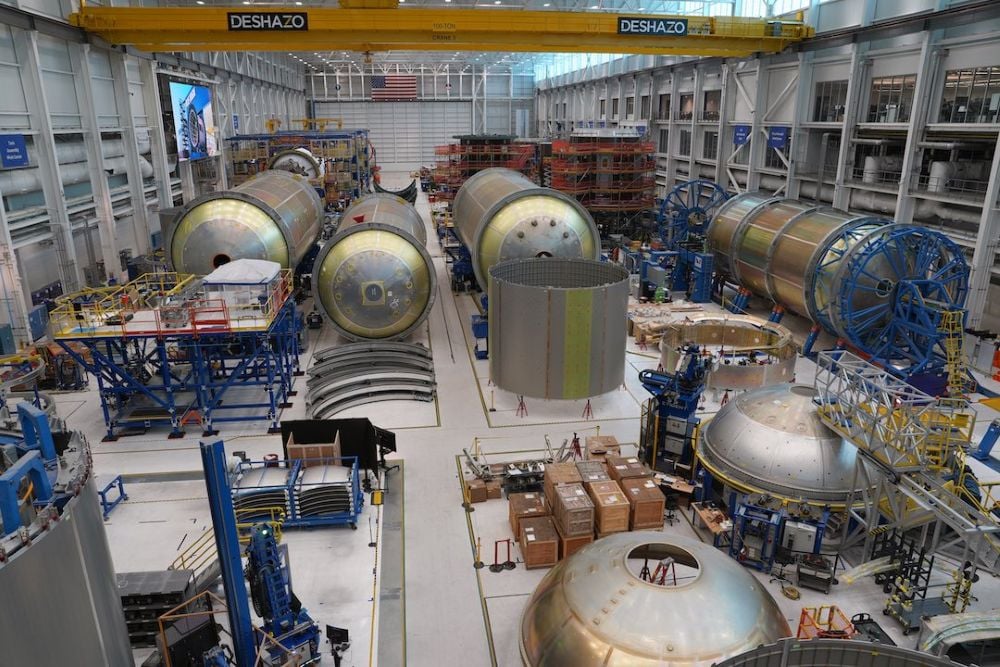
🛰️ Blue Origin Files Project Sunrise FCC Application for 51,600-Satellite Orbital Data Center Constellation
On March 19, 2026, Blue Origin filed an FCC application for Project Sunrise, a constellation of up to 51,600 satellites in sun-synchronous orbits between 500 and 1,800 kilometers altitude. The filing describes spacecraft primarily communicating through optical inter-satellite links, with Ka-band reserved for telemetry and control — an architecture that sidesteps the spectrum congestion problems that have stalled terrestrial data relay. Each orbital plane would carry between 300 and 1,000 satellites, spaced 5–10 kilometers apart in altitude to minimize cascade debris risk.
The commercial rationale is unambiguous: solar energy at orbital altitude costs approximately $0.005/kWh, versus $0.05–0.15/kWh for grid-delivered electricity on the ground, and zero water is consumed for cooling. Blue Origin frames Project Sunrise as a way to "ease mounting pressure on U.S. communities and natural resources by shifting energy- and water-intensive compute away from terrestrial data centers" — a rhetorical move that positions orbital compute as environmental relief rather than speculative infrastructure play.
The connectivity layer is as revealing as the compute layer. Project Sunrise would route data through TeraWave, Blue Origin's January 2026 broadband constellation targeting 6 terabits-per-second symmetrical throughput. The two-constellation stack — compute nodes relaying through a dedicated optical backbone — mirrors the architectural logic of Starlink's approach but with a distinct separation: Project Sunrise satellites will not handle internet connectivity; they will handle inference workloads and route results terrestrially. This specialization may prove to be a meaningful design advantage over constellation designs that attempt both functions in the same hardware layer.
Blue Origin's filing also signals competitive intent through its objections. The company called SpaceX's million-satellite filing "profoundly disproportionate" and argued it risks rendering the orbital environment permanently unusable for other operators. Amazon backed the critique, noting SpaceX's application lacks the technical specificity needed to guarantee it could complete deployment in under a century. This is regulatory combat dressed as safety concern: Blue Origin is simultaneously filing for 51,600 of its own satellites while arguing the space is too crowded for SpaceX's 1,000,000.
The New Glenn rocket is the logistical enabler. Having completed two successful launches — including the NG-2 ESCAPADE Mars mission with successful booster landing — Blue Origin now has an operational heavy-lift vehicle that can self-launch Project Sunrise hardware at "previously unattainable" price points, avoiding the dependency on SpaceX rideshare that constrained its earlier competitors. The gap between filing and orbital node is still measured in years, but the architecture and the launch vehicle are now both real.
---
⚡ NVIDIA Space-1 Vera Rubin Module Delivers 25× AI Compute Uplift for Six Orbital Compute Partners
At GTC 2026 on March 16, NVIDIA announced the Space-1 Vera Rubin Module, a compute platform engineered specifically for size-, weight-, and power (SWaP)-constrained orbital environments. The Rubin GPU delivers 25× the AI compute of the H100 for space-based inferencing — a figure that signals a deliberate performance boundary: enough throughput for real-time image analysis and sensor fusion, not enough for frontier model training at scale. This is not NVIDIA chasing the orbital data center story opportunistically. Six companies — Aetherflux, Axiom Space, Kepler Communications, Planet Labs, Sophia Space, and Starcloud — are already committed to deploying NVIDIA hardware in orbit.
The platform tiering reveals NVIDIA's architecture for the market. The Space-1 Rubin Module targets orbital data centers and geospatial intelligence applications requiring sustained throughput. The IGX Thor handles autonomous space operations where deterministic latency matters more than peak compute. The Jetson Orin occupies the edge tier: compact, energy-efficient inference for onboard sensor processing. The three-tier stack maps precisely onto the emerging orbital compute value chain — training offloaded terrestrially, heavy inference running in ODC clusters, autonomous operations running on each spacecraft node.
Jensen Huang's framing at GTC was precise: "Intelligence must live wherever data is generated." The maxim encodes a latency argument. Earth-observation data processed onboard can produce actionable outputs in milliseconds; the same data relayed to ground and back adds seconds to minutes depending on constellation coverage. For applications like maritime surveillance, wildfire monitoring, or infrastructure anomaly detection, that latency delta matters operationally. NVIDIA is positioning Rubin Module as the chip that closes it.
The Planet Labs partnership is the most operationally advanced of the six. Planet already operates hundreds of imaging satellites and has years of onboard-processing data. The new GPU-native AI engine built on NVIDIA accelerated computing will process imagery in orbit before transmission, compressing the data pipeline in both bandwidth and latency. What Planet is building is not an orbital data center in the speculative filing sense — it is a deployed inference fleet with known customers and real revenues. That distinction matters as the field fills with FCC applications that may take a decade to materialize.
The Kepler Communications deployment — launching scalable cloud infrastructure powered by NVIDIA — extends the model to general orbital cloud services rather than Earth observation specifically. Kepler's inter-satellite optical mesh becomes a cloud fabric; the NVIDIA hardware becomes the compute substrate. The combination begins to resemble a distributed data center architecturally, even if it remains a proof-of-concept fleet rather than a commercial hyperscale operation. The important signal is that NVIDIA has secured its position as the silicon layer for the orbital compute stack before any single orbital data center architecture has achieved dominance.
---
🇨🇳 China's Three-Body Computing Constellation Completes In-Orbit Testing, Moves Toward Operational Phase
The gap between Western filing and Chinese deployment widened materially in February 2026. While Blue Origin submitted its first FCC application and SpaceX was still seeking clarification on spectrum allocation, China announced the completion of nine months of in-orbit testing for its Three-Body Computing Constellation — the ADA Space and Zhejiang Lab joint program that launched its first 12 satellites in May 2025 from the Jiuquan Satellite Launch Center. The test phase covered satellite-to-satellite link stability, radiation performance of onboard AI accelerators, and distributed inference across nodes at orbital separation. The transition from testing to operational phase marks a structural milestone that no Western orbital compute program has yet achieved.
The architectural design of the Three-Body constellation reflects a different engineering philosophy than the US approaches. Rather than concentrating compute in large orbital data center nodes — which creates the thermal dissipation problem — ADA Space distributes workloads across a dense mesh of smaller satellites, each carrying AI inference processors rated at roughly 1 peta-operation per second. At full 2,800-satellite deployment, the constellation will achieve a combined 1,000 POPS (peta-operations per second), equivalent to a large terrestrial AI cluster. The inter-satellite links use 10 Gbps optical connections for low-latency data routing across the mesh, reducing dependence on ground stations for node-to-node coordination.
The geopolitical reading is explicit in Chinese technical commentary: control of orbital compute infrastructure carries sovereignty implications analogous to GPS. A nation that controls the master control layer of a global computing constellation can selectively deny service or prioritize its own workloads — the same structural leverage that makes GPS dual-use. The Three-Body constellation is framed domestically not as a data center project but as critical national infrastructure, with the China National Space Agency listed as a formal partner alongside the commercial and academic institutions.
The US-China gap is not rhetorical. The Three-Body constellation has hardware in orbit, operating inference workloads, with tested inter-satellite links. The US's largest proposals — SpaceX's million satellites, Blue Origin's 51,600 — remain in the FCC application queue, pending spectrum allocation decisions that could take years. Starcloud has launched a single GPU as a proof-of-concept. Axiom Space deployed experimental orbital computing nodes on the ISS in January 2026. The operational distance between the two programs is measured in years, not engineering capability.
The sovereignty dimension of the Three-Body program is operational, not rhetorical. China's military surveillance applications rely on real-time maritime and terrestrial AI analysis from orbital assets — workloads that benefit directly from in-orbit inference rather than ground relay. A constellation that processes surveillance data in orbit, inside Chinese sovereign infrastructure, has no point at which that data traverses a foreign communication link. The Three-Body constellation's first operational application is not civilian climate monitoring: it is denial-of-access to the data stream.
---
📊 FCC Spectrum Queue Now Holds Three Competing Megaconstellation Bids Totaling 1.2M Satellites
The Federal Communications Commission now holds three active large-scale orbital data center applications totaling approximately 1.2 million satellite slots: SpaceX's January 2026 filing for 1,000,000 satellites in 50-km-thick orbital shells between 500 and 2,000 km altitude; Starcloud's February 2026 application for 88,000 satellites; and Blue Origin's March 19 Project Sunrise filing for 51,600. Google's Project Suncatcher, in partnership with Planet Labs for two demonstration spacecraft, is expected to follow. The FCC has accepted all three for filing review but has not yet granted authorization to any.
The regulatory question is not whether orbital data centers are technically feasible — the FCC implicitly accepted that premise by accepting the filings. The question is orbital allocation: how does the Commission adjudicate competing claims on a finite and increasingly congested orbital resource? The SpaceX filing drew immediate objections from Amazon and Blue Origin, arguing the application lacked sufficient technical detail to demonstrate debris-safe operations at scale. The FCC responded by requiring SpaceX to provide additional interference analysis in the 17.3–17.8 GHz uplink band before full processing.
Blue Origin's filing requests a waiver from standard FCC milestone rules, which would require half the constellation in orbit six years after authorization and the full constellation within nine years. This waiver request signals that Blue Origin regards the constellation timeline as aspirational rather than contractual — a positioning move to hold orbital slots while the business case matures, rather than a commitment to specific deployment dates. Starcloud's application, by contrast, has an existing operational satellite and a second launch slated for H2 2026, making its filing the most credible near-term contender despite its startup status.
The spectrum queue dynamic creates a structural pressure that is independent of technical readiness. FCC authorization operates on a "use it or lose it" principle with milestone checkpoints. Any company that secures authorization but misses milestones risks forfeiting its orbital slot allocation to the next applicant. This creates perverse incentives to launch placeholder satellites early rather than wait for mature hardware — the same logic that produced the speculative LEO broadband launches of the early 2020s. The orbital data center race is already beginning to exhibit the same milestone-gaming dynamics, with waivers requested in the first round of filings.
The aggregate implied satellite count — 1.2 million from three applications alone — is not physically achievable without multiple Starship-class heavy-lift vehicles operating at high cadence. At current launch rates, the filing queue represents a decade or more of orbital delivery work even assuming full regulatory approval and no technical delays. The practical constraint is not spectrum but logistics: getting that hardware to orbit at costs that make the economics work.
---
🔬 The Physics Wall: Why Thermal Dissipation Is the Hidden Gate on Orbital Compute Scale
Every orbital data center architecture ultimately collides with the same thermodynamic constraint: vacuum has no convective cooling, and radiative heat rejection scales as the fourth power of temperature. A terrestrial hyperscale data center dissipates heat through water cooling at $0.30–0.50/kWh of cooling cost; in orbit, the same thermal load requires radiator panels sized to match. IEEE Spectrum's recent analysis estimates that a one-gigawatt orbital facility would require approximately 834,000 square meters of radiator surface — roughly the footprint of 115 football fields — to safely dissipate waste heat. No current satellite architecture operates at anywhere near that scale.
The engineering solutions being developed split into two camps. SpaceX's distributed architecture — 1,000,000 satellites each carrying modest compute — dissolves the thermal problem by refusing to concentrate it. Each satellite handles a manageable thermal load that can be rejected through body-mounted radiator panels within standard mass budgets. The physics argument for this approach is compelling: scaling compute by adding nodes rather than densifying existing nodes avoids the radiator scaling wall entirely. The tradeoff is network complexity — coordinating inference workloads across a million loosely coupled nodes requires a distributed systems architecture that does not yet exist at orbital scale.
China's Three-Body constellation adopts a middle path: satellite nodes sized for approximately 1 POPS each, with the aggregate scale achieved through the 2,800-satellite mesh. The thermal profile per node stays within achievable radiator budgets while the network achieves meaningful combined throughput. NVIDIA's Vera Rubin Space-1 Module is designed specifically for this thermal envelope: the Rubin GPU is rated for the radiation environment and sized for the power and radiator constraints that apply inside a satellite bus, not a terrestrial server rack.
The radiation environment adds a second physics constraint that is less discussed but equally fundamental. Cosmic ray bombardment in LEO causes single-event upsets (SEUs) in semiconductor logic — transient bit flips that corrupt computation results without permanently damaging hardware. Standard terrestrial GPU architectures are not designed for SEU environments. Research from the Chaohu-1 SAR satellite program demonstrates application-aware radiation tolerance — selectively hardening layers of deep neural networks against SEU sensitivity — suppressing radiation errors to near zero while improving inference speed by 8.4–33%. This requires co-design of model architecture with chip hardening strategy. NVIDIA's GTC 2026 announcement that Space-1 Rubin Module is "engineered for SWaP-constrained environments" encodes this constraint: the performance specifications are for the orbital envelope, not terrestrial benchmarks. Scientific American notes that chips require replacement every five to six years due to cumulative total ionizing dose — a supply chain requirement with no terrestrial analogue that adds 3–5 launch cycles to a 20-year constellation's total cost of ownership.
The thermal and radiation walls together define the real frontier of orbital compute: not spectrum allocation or launch costs, but the materials science and chip architecture challenges that determine how much compute you can put inside a satellite that can survive five years in LEO without burning itself or flipping bits at scale.
---
🌐 Vertical Integration as the Orbital Moat: Connectivity + Compute Ownership as Strategic Asymmetry
The pattern emerging across orbital compute entrants is not convergence on a single architecture — it is divergence along a vertical integration axis. Companies that control both the compute layer and the connectivity layer of the orbital stack occupy a structurally different competitive position than those that control only one.
Blue Origin's Project Sunrise + TeraWave combination gives it 4/4 vertical integration across compute nodes, optical inter-satellite links, ground connectivity, and launch vehicle. SpaceX's Starlink constellation plus compute filing gives it the same score: compute, inter-satellite laser links, ground gateways, and Falcon 9/Starship for deployment. China's Three-Body program scores 3/4 — compute, inter-satellite optical mesh, and national space agency launch access — but lacks a commercial ground connectivity product that Western operators could independently access.
Starcloud scores 1/4: compute hardware only, with launch, connectivity, and ground infrastructure procured from external partners. Kepler Communications, deploying NVIDIA hardware on its optical mesh network, scores 2/4: compute and inter-satellite connectivity, but dependent on third-party launch and limited ground coverage. The asymmetry matters because orbital data center economics depend critically on the cost of moving data between nodes and to the ground — and companies that own that pipe can set transfer pricing for operators who don't.
This structural dynamic — supplier economics flowing to the connectivity layer rather than the compute layer — parallels the terrestrial cloud economics that shaped AWS's dominance. S3 and EC2 are often cited, but the strategic moat was always network egress pricing. Orbital compute will likely exhibit the same pattern: whoever controls the inter-satellite link fabric and ground gateway infrastructure captures surplus value from operators running workloads on third-party compute. NVIDIA recognized this early; its six orbital compute partners include Kepler Communications specifically because Kepler owns the connectivity layer that NVIDIA's compute hardware will run on top of.
The Breakthrough Institute's critical analysis of orbital data centers argues that the economic case remains unproven at every layer: chip replacement cycles, launch cost assumptions, radiation hardening costs, and regulatory timelines all point toward timelines longer than promotional materials suggest. The vertical integration analysis partially resolves this skepticism — it identifies which entrants will capture economics even if the orbital compute market matures more slowly than current filings imply. Companies with full-stack control can extract value from connectivity services to existing customers while compute revenue develops; companies with compute-only positions are betting entirely on a market that does not yet exist.
The orbital compute moat is being built now, through FCC filings, launch vehicle development, and partnership agreements, not through operational revenue. The window for acquiring vertical integration positions is a 2–3 year window before regulatory decisions crystalize and launch slots are committed.
---
Research Papers
A Case for Application-Aware Space Radiation Tolerance in Orbital Computing — Ke Chen et al. (July 2024, updated citations Feb 2026) — Introduces RedNet, a radiation-tolerant DNN architecture validated on the Chaohu-1 SAR satellite. Demonstrates SEU suppression to ≈0 and 8.4–33% inference speed improvement. Directly relevant to NVIDIA's Space-1 Rubin Module design philosophy of co-designing inference hardware with the radiation environment.
Orbit-Aware Split Learning: Optimizing LEO Satellite Networks for Distributed Online Learning — SOFIA project / MICIU/AEI consortium (January 2026) — Proposes split learning architectures optimized for LEO orbital parameters, including coverage gaps and inter-satellite handoff. Addresses the distributed systems challenge that makes coordinating inference across 1,000+ satellite nodes non-trivial. Most relevant to Three-Body constellation's mesh coordination problem.
First On-Orbit Demonstration of a Geospatial Foundation Model — IMAGIN-e / ISS team (December 2025) — Demonstrates reliable on-orbit inference of a geospatial foundation model (GeoFM) on the ISS using the IMAGIN-e payload. Establishes that large geospatial models can be compressed and deployed in flight-constrained hardware, creating a pathway from terrestrial GeoFMs to Planet Labs-style deployed inference fleets. Validates NVIDIA's Planet Labs partnership from a systems architecture perspective.
Satellite Edge AI with Large Models: Architectures and Technologies — Chinese Institute of Electronics collaboration (April 2025) — Proposes federated fine-tuning and microservice-empowered inference architectures for satellite edge deployment of large AI models. The microservice decomposition approach directly maps to the distributed inference coordination problem that the Three-Body constellation is solving at hardware level; this paper provides the software layer design rationale.
---
Implications
The week ending March 26, 2026 is a structural inflection point for orbital compute — not because anything has been deployed at scale, but because the institutional actors and technical architectures for the next decade are now visible simultaneously. Blue Origin's Project Sunrise filing, NVIDIA's Space-1 platform launch, and China's transition to operational status in the Three-Body constellation form a triad that defines the competitive landscape.
The most important insight is the operational vs. rhetorical gap. China has hardware in orbit running inference workloads. Every US program of comparable scale is in the FCC queue. This gap — measured in years of operational experience, radiation data, and distributed inference validation — is not recoverable by filing more applications. Western operators are building the policy and business case for orbital compute while China is building the data. By the time US megaconstellation applications navigate the regulatory process, the Three-Body constellation will have accumulated years of operational data on distributed orbital AI inference at scale. That data will be used to design the next generation of hardware, creating a compound advantage that FCC authorization cannot replicate.
NVIDIA's position is the clearest near-term strategic read. By committing six partners — Aetherflux, Axiom, Kepler, Planet, Sophia Space, Starcloud — across compute, connectivity, Earth observation, and cloud layers at GTC 2026, NVIDIA secured silicon incumbency before any single orbital architecture achieved market dominance. The Space-1 Rubin Module delivers 25× H100 performance in an orbital envelope and will operate inside Kepler's inter-satellite mesh and Planet's Earth observation fleet within 12–18 months, generating revenue regardless of which megaconstellation filing achieves full deployment. The silicon vendor captures margin from all competitors simultaneously; the hyperscale operators are still in regulatory review.
The vertical integration analysis reveals the structural bet each entrant is making. Blue Origin is betting that owning compute, connectivity, and launch — the full stack — produces Starlink-like returns at a decade delay. SpaceX is betting that extreme satellite count distributes the thermal and radiation problems away while its existing Starlink ground infrastructure amortizes the connectivity layer. Starcloud is betting that first-mover operational data and NVIDIA partnership produce differentiated compute products that larger players will need to acquire or license. The Breakthrough Institute's skepticism about orbital data center economics is correct for any single-layer entrant; it is less applicable to full-stack operators with interim revenue from connectivity services.
The governance gap is structural, not procedural. Three US companies have filed for a combined 1.14 million satellite slots in a physical environment governed by a domestic regulator using rules designed for broadband constellations. The orbital resource is global; the regulatory process is bilateral at best. China's Three-Body constellation faces no FCC review because it operates under CNSA authorization. No ITU framework currently adjudicates compute-specific orbital allocation claims across geopolitical boundaries. The governance asymmetry means that US orbital compute must navigate a multi-year public proceeding — with Amazon and Blue Origin objecting to SpaceX, and SpaceX presumably preparing reciprocal objections — while Chinese programs operate on a domestic approval timeline that has already produced operational hardware. The intelligence implications compound this asymmetry: a Chinese constellation running military surveillance inference in orbit, inside sovereign infrastructure with no foreign link exposure, represents a capability that US programs cannot match from the filing queue. The race is real; the referee covers only half the track.
---
HEURISTICS
`yaml
- id: orbital-vertical-integration-scoring
- id: operational-vs-rhetorical-gap-orbital
- id: thermal-radiation-bound-on-orbital-compute-density
`