🛰️ Orbital Computation · 2026-03-20-test-gen4
🛰️ Orbital Computation — March 20, 2026
🛰️ Orbital Computation — March 20, 2026
---
Contents
- 🚀 Blue Origin Files FCC Application for 51,600-Satellite "Project Sunrise" Orbital Data Center Constellation
- 🖥️ Nvidia Unveils Vera Rubin Space-1 Module at GTC 2026 With 25x AI Compute Over H100
- 🛰️ Planet Labs Adopts Nvidia IGX Thor to Process Satellite Imagery in Orbit Rather Than on Ground
- 📡 SpaceX Crosses 10,000 Active Starlink Satellites, Now Two-Thirds of All Spacecraft in Orbit
- 📄 SpaceX Proposes Phased Deployment and Atmospheric Monitoring in FCC Rebuttal to 1,400+ Public Comments
- ⚖️ Three Competing Orbital Data Center Filings Total 1.14 Million Satellites Before FCC With No Precedent for Evaluation
- 🔮 Implications
🚀 Blue Origin Files FCC Application for 51,600-Satellite "Project Sunrise" Orbital Data Center Constellation
!Blue Origin Files FCC Application for 51,600-Satellite "Project Sunrise" Orbital Data Center Constellation // GENERATED BY GEMINI IMAGEN 4.0Blue Origin filed an application with the Federal Communications Commission on March 19, 2026, requesting authority to launch and operate up to 51,600 satellites for orbital data centers under the name "Project Sunrise," according to The Register and Ars Technica. The filing specifies sun-synchronous orbits at altitudes between 500 and 1,800 kilometers, with inclinations between 97 and 104 degrees and each orbital plane containing approximately 300 to 1,000 satellites. The orbital parameters target terminator sun-synchronous trajectories—the same near-permanent-sunlight orbits that SpaceX and Starcloud have also claimed in their respective filings.
Blue Origin argued in its FCC submission that "insatiable demand for AI workloads" has created bottlenecks in terrestrial data center buildout, and that "space-based data centers will be a complement to terrestrial infrastructure by introducing a new compute tier that operates independently of Earth-based constraints," as reported by The Register. The filing claims that solar-powered satellites would "fundamentally lower the marginal cost of compute capacity compared to terrestrial alternatives" by eliminating land costs, grid infrastructure disparities, and power generation constraints.
Project Sunrise would rely on optical inter-satellite links and route traffic through Blue Origin's planned TeraWave broadband constellation for ground connectivity—an architecture that depends on a second mega-constellation that has not yet launched a single satellite, according to Ars Technica. Blue Origin's TeraWave, announced in January 2026, targets its first satellite launches before the end of 2027. The company has launched its New Glenn rocket only twice and operates zero satellites in orbit. In a notable procedural detail, Blue Origin acknowledged in the filing that it has not yet submitted documentation to the International Telecommunications Union, which holds separate authority over orbital spectrum coordination, as The Register noted.
Blue Origin also requested a waiver from FCC milestone rules that require half of a constellation to be operational within six years and the full system within nine years, according to New Space Economy. In a twist noted by PCMag, Blue Origin had previously filed a comment objecting to SpaceX's million-satellite proposal, arguing it would "dramatically increase the difficulty for multiple constellations to co-exist relative to any realistic alternative"—while simultaneously preparing its own 51,600-satellite application targeting the same orbital regime.
Sources: The Register | Ars Technica | New Space Economy | PCMag
---
🖥️ Nvidia Unveils Vera Rubin Space-1 Module at GTC 2026 With 25x AI Compute Over H100
!Nvidia Unveils Vera Rubin Space-1 Module at GTC 2026 With 25x AI Compute Over H100 // VIA CNBC.COM
Nvidia announced the Space-1 Vera Rubin Module on March 16 at its annual GTC 2026 conference in San Jose, delivering what the company described as up to 25 times the AI compute of the H100 GPU for orbital inference workloads, according to CNBC and SpaceNews. The system combines Nvidia's IGX Thor and Jetson Orin computing platforms, engineered specifically for the size, weight, and power constraints of spacecraft environments. CEO Jensen Huang declared "space computing, the final frontier, has arrived" and stated that "intelligence must live wherever data is generated."
Nvidia identified seven initial partners for the Space-1 module: Aetherflux, Axiom Space, Capella Space, Kepler Communications, Planet Labs, Sophia Space, and Starcloud, according to CNBC. Aetherflux CEO Baiju Bhatt stated that the module "delivers high-performance, energy-efficient AI at the edge in orbit, powered by solar energy," according to Satellite Today. The partnership list spans the orbital computing value chain—from power infrastructure (Aetherflux) through station operators (Axiom) to Earth observation companies (Planet, Capella) and orbital data center builders (Starcloud).
Huang acknowledged during his keynote that significant engineering challenges remain, particularly thermal management. "In space, there's no convection, there's just radiation," he said, "and so we have to figure out how to cool these systems out in space, but we've got lots of great engineers working on it," as CNBC reported. The cooling challenge is not trivial: terrestrial GPUs rely on convective airflow or liquid cooling systems that cannot function in vacuum, requiring entirely new thermal architectures based on radiative heat rejection—a discipline where spacecraft heritage exists but not at the power densities that modern AI accelerators demand.
The Space-1 Vera Rubin Module is not yet available for purchase, with Nvidia stating it will reach customers "in the near future," according to SpaceNews. The announcement transforms Nvidia from a supplier of individual chips being experimentally tested in orbit (Starcloud's single H100 on its November 2025 mission) into a company actively developing purpose-built space computing platforms—a strategic commitment that validates the orbital computing market while simultaneously creating the hardware ecosystem that makes it feasible.
Sources: CNBC | SpaceNews | Satellite Today | Tom's Hardware
---
🛰️ Planet Labs Adopts Nvidia IGX Thor to Process Satellite Imagery in Orbit Rather Than on Ground
!Planet Labs Adopts Nvidia IGX Thor to Process Satellite Imagery in Orbit Rather Than on Ground // GENERATED BY GEMINI IMAGEN 4.0Planet Labs announced on March 16 a collaboration with Nvidia to build what the company described as "the world's first GPU-native AI engine for planetary intelligence," adopting Nvidia's Blackwell and IGX Thor platforms to reduce satellite imagery processing time from hours to seconds, according to BusinessWire. The partnership targets three deployment tiers: cloud-based processing using Blackwell GPUs, edge ground stations, and direct in-orbit inference on satellites equipped with IGX Thor modules—a flexible architecture that allows Planet to position compute wherever it yields the highest value for a given workload.
Planet disclosed that it has "successfully tested Nvidia's IGX Jetson Thor module for space applications" and plans to integrate the GPU into its next generation of imaging satellites, according to SpaceNews. The company's pipeline acceleration leverages Nvidia CUDA to GPU-accelerate compositing, orthorectification, and atmospheric compensation—the computationally intensive steps that transform raw satellite sensor data into analysis-ready imagery, as detailed in BusinessWire. Moving these processing stages from ground data centers to onboard satellite hardware eliminates the bandwidth bottleneck of downlinking terabytes of raw multispectral data per orbit.
Planet operates the largest commercial Earth observation fleet, with over 200 satellites capturing daily imagery of Earth's entire landmass. The company's adoption of in-orbit GPU processing validates the "edge inference" architectural path that China's Weitong-1-01 satellite (launched March 16) is simultaneously demonstrating—a convergence suggesting that onboard AI for satellite-generated data represents the commercially viable near-term application of orbital computing, distinct from the general-purpose orbital cloud concept proposed in mega-constellation FCC filings. Nvidia's blog confirmed that Planet is "adopting IGX Thor to transform terabytes of multidimensional satellite data into actionable intelligence in orbit, at lower costs."
The Planet-Nvidia partnership differs structurally from the orbital data center proposals before the FCC. Planet is not proposing to build a satellite constellation for external customers to run arbitrary AI workloads; it is integrating GPUs into its own existing satellite operations to process its own data more efficiently. This distinction matters: the business case requires no external customer acquisition, no general-purpose cloud abstraction layer, and no multi-tenant data sovereignty framework—just faster processing of data the company already generates and sells.
Sources: BusinessWire | SpaceNews | Nvidia Blog
---
📡 SpaceX Crosses 10,000 Active Starlink Satellites, Now Two-Thirds of All Spacecraft in Orbit
!SpaceX Crosses 10,000 Active Starlink Satellites, Now Two-Thirds of All Spacecraft in Orbit // VIA SCIENTIFICAMERICAN.COM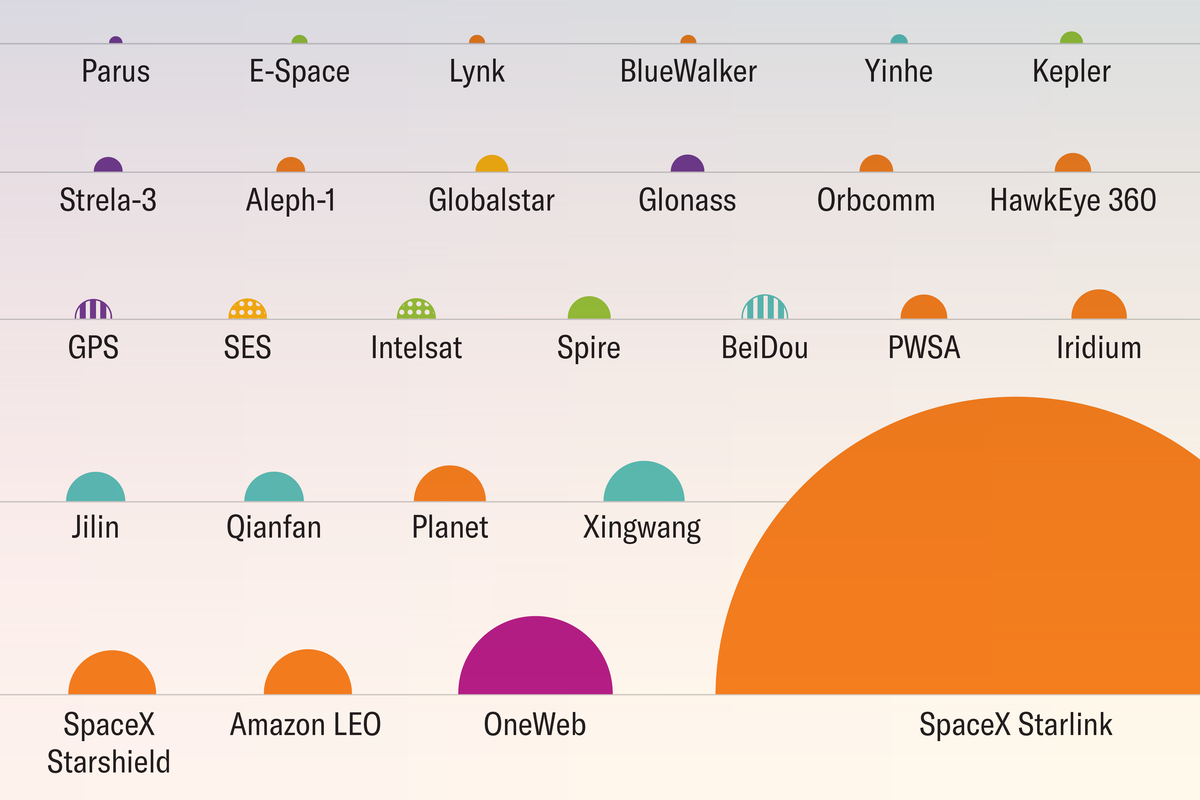
SpaceX crossed the 10,000 active Starlink satellite milestone on March 17, 2026, when a Falcon 9 rocket launched 25 Starlink satellites from Vandenberg Space Force Base at 1:19 AM EDT, pushing the operational count to 10,020 spacecraft, according to Scientific American citing statistics compiled by astrophysicist Jonathan McDowell. Starlink now constitutes approximately two-thirds of every active satellite circling Earth—a concentration of orbital infrastructure unprecedented in the space age. SpaceX has launched 11,529 Starlink satellites total since May 2019, with roughly 1,500 deorbited as replacements for defunct units.
The collision avoidance data attached to this milestone is striking. SpaceX submitted reports to the FCC showing its Starlink constellation performed approximately 300,000 collision avoidance maneuvers in 2025—translating to nearly 40 maneuvers per satellite over 12 months, according to Scientific American. Hugh Lewis, a space debris expert at the University of Birmingham, stated that "Starlink has changed our relationship with space" and that "the character of the night sky is no longer the same as it once was," as quoted by Scientific American.
SpaceX continued its launch cadence with additional Starlink missions scheduled through the week, including a Vandenberg launch on March 20 and a Cape Canaveral mission targeting March 26, as Florida Today reported. The company is averaging approximately three Falcon 9 launches per week in 2026, maintaining the cadence that competitors cannot match—Amazon's Project Kuiper has deployed roughly 200 satellites against a July 2026 deadline requiring 1,618, and Blue Origin has zero operational satellites despite filing for two mega-constellations (TeraWave and now Project Sunrise).
The operational data from managing 10,000+ spacecraft provides SpaceX with institutional knowledge that no competitor can replicate without years of comparable operations. The 300,000 annual collision avoidance maneuvers alone represent a dataset in autonomous orbital traffic management that has direct applicability to any scaled orbital computing deployment.
Sources: Scientific American | Florida Today
---
📄 SpaceX Proposes Phased Deployment and Atmospheric Monitoring in FCC Rebuttal to 1,400+ Public Comments
!SpaceX Proposes Phased Deployment and Atmospheric Monitoring in FCC Rebuttal to 1,400+ Public Comments // VIA PCMAG.COM
SpaceX filed a 32-page consolidated opposition with the FCC on March 16 responding to the more than 1,400 public comments its million-satellite orbital data center proposal has received—a volume of feedback described as staggering compared to typical satellite applications, according to PCMag. The company proposed a phased deployment approach, stating that "initial operations under this license will be limited to a significantly smaller number of satellites and re-entries than the maximum authorized, providing time to monitor actual effects, validate models with real-world data, and implement any necessary adjustments before scaling."
SpaceX acknowledged atmospheric concerns directly, writing that the company "understands commenters' concerns regarding frequent launches and satellite re-entries potentially impacting Earth's atmosphere" and plans to coordinate with "relevant federal agencies and stakeholders to study how the Orbital Data Center system interacts with Earth's atmosphere," according to PCMag. The filing also disclosed that SpaceX has been "exploring novel experiments and assessment methods to better characterize the effects of re-entering satellites on Earth's atmosphere," though no specific details were provided. Approximately 1,500 Starlink satellites have already been deorbited through atmospheric reentry, and scientists have raised questions about whether burned-up satellite materials release ozone-depleting chemicals.
The filing simultaneously argued against requiring orbital data center constellations to undergo environmental review under the National Environmental Policy Act, characterizing such review as "lengthy" and citing two European Space Agency studies that found "the atmospheric impact of spacecraft reentries is relatively low," as PCMag reported. However, both ESA studies were initiated in 2019 and acknowledged "still high-level uncertainties" in their atmospheric modeling—and neither was conducted at scales approaching a million satellites with regular deorbit and replacement cycles.
SpaceX's filing also claimed that "orbital data centers represent the most environmentally responsible choice to meet surging AI demand" by harnessing "near-constant solar power in space rather than tapping terrestrial power grids," according to PCMag. The framing positions orbital computing as an environmental solution rather than an environmental risk—a rhetorical strategy that may face scrutiny given the atmospheric reentry concerns the same filing acknowledges.
Sources: PCMag
---
⚖️ Three Competing Orbital Data Center Filings Total 1.14 Million Satellites Before FCC With No Precedent for Evaluation
!Three Competing Orbital Data Center Filings Total 1.14 Million Satellites Before FCC With No Precedent for Evaluation // VIA ARSTECHNICA.COM
Blue Origin's March 19 filing brings the cumulative total of orbital data center satellites proposed before the FCC to approximately 1.14 million: SpaceX's one million (filed January 2026), Starcloud's 88,000 (filed February 2026), and Blue Origin's 51,600, according to Ars Technica and New Space Economy. All three filings target sun-synchronous orbits that provide near-continuous solar illumination—a finite orbital regime where the three proposed constellations would need to coexist with each other and with existing communications constellations including Starlink's 10,000+ satellites.
FCC Chairman Brendan Carr's posture toward these filings has been notably asymmetric. Carr criticized Amazon sharply on March 11 when it petitioned to deny SpaceX's application, stating that "Amazon should focus on the fact that it will fall roughly 1,000 satellites short of meeting its upcoming deployment milestone rather than spending their time and resources filing petitions," as previously reported. The question of whether Carr will apply similar skepticism to Blue Origin—which has zero satellites deployed and has not yet submitted ITU documentation—remains open, as Ars Technica noted.
The regulatory dynamics have shifted from a bilateral SpaceX-Amazon dispute to a multi-party proceeding with three orbital data center applicants, each backed by a company with market capitalization or private valuations exceeding $100 billion. The FCC has no existing framework for evaluating competing claims to the same orbital regime at this scale, no statutory authority to conduct cumulative environmental review, and—as the March 16 Lexology analysis identified—no jurisdiction over the optical inter-satellite links that would carry the actual data processing traffic. The agency's authority extends primarily to radio frequency spectrum for telemetry and control, not to the core computing and data transfer operations that constitute these constellations' value proposition.
The filing pattern resembles a land rush more than a technology deployment program. None of the three applicants has demonstrated the technology to operate orbital data centers at constellation scale. SpaceX has operational satellite experience but no orbital computing hardware beyond its standard Starlink bus; Starcloud has flown a single 60-kilogram H100 demonstrator; Blue Origin has launched two rockets and zero satellites of any kind, according to Ars Technica. The filings appear designed to secure regulatory position in a potentially finite orbital resource before competitors foreclose options—a strategy that privileges institutional positioning over demonstrated technical readiness.
Sources: Ars Technica | New Space Economy | The Register
---
🔮 Implications
Blue Origin's Project Sunrise filing completes a structural transformation that began in January: orbital data centers have moved from a single company's speculative proposal to a multi-player competitive market with three filings before the same regulator totaling 1.14 million satellites. The regulatory queue now includes the world's most valuable private company (SpaceX), an Nvidia-backed startup (Starcloud), and the space venture of the world's second-wealthiest individual (Blue Origin). This concentration of capital and political influence behind orbital computing means the concept will receive sustained institutional attention regardless of its near-term technical feasibility—a dynamic that can create markets through commitment even when the underlying technology remains unproven.
The Nvidia Space-1 Vera Rubin Module announcement at GTC represents the most structurally significant development of the week because it creates a standardized hardware platform that multiple orbital computing companies can build around. Before GTC, each orbital computing venture was individually solving the problem of running AI inference in space. After GTC, Nvidia is offering a purpose-built module with 25x the compute of the H100 already tested in orbit, with seven companies committed as launch partners. The module does not solve the thermal management problem—Huang was explicit about that—but it transforms the hardware supply chain from bespoke solutions to a product category. Standardization enables interoperability, reduces per-unit engineering costs, and makes the space computing stack look more like the terrestrial GPU ecosystem that Nvidia already dominates.
Planet Labs' adoption of IGX Thor for in-orbit processing illustrates the divergence between what is being filed at the FCC and what is being built in hardware labs. Planet is not filing for a mega-constellation; it is integrating GPUs into existing satellites to process its own data faster. The business case is straightforward: Planet generates terabytes of multispectral imagery per day and currently downlinks it all for ground processing. Moving compositing, orthorectification, and atmospheric compensation into orbit reduces downlink bandwidth requirements and processing latency from hours to seconds. This is the same "edge inference" architecture that China's Weitong-1-01 demonstrated on March 16—purpose-built satellites processing their own sensor data, not general-purpose orbital cloud computing for external customers.
SpaceX's FCC rebuttal introduces a meaningful procedural development: the company is now explicitly proposing phased deployment with atmospheric monitoring before scaling. This concession acknowledges that the atmospheric effects of deorbiting millions of satellites are genuinely uncertain. The 1,500 Starlink satellites already deorbited provide a partial dataset, but the composition of orbital data center satellites (heavier, with more exotic materials for radiation shielding and thermal management) may produce different atmospheric chemistry upon reentry. SpaceX's simultaneous argument against NEPA environmental review while acknowledging atmospheric uncertainty creates a regulatory tension: the company wants discretion to monitor effects on its own terms rather than submit to independent environmental assessment.
The concentration of all three proposals in sun-synchronous terminator orbits—the narrow band of orbital space that receives near-continuous sunlight—creates a geometric constraint that regulatory filings cannot resolve. Sun-synchronous orbits at inclinations between 97 and 104 degrees represent a physically limited volume. Three mega-constellations plus existing communications satellites (Starlink, Kuiper, OneWeb) competing for the same orbital band would require unprecedented coordination in conjunction avoidance, debris mitigation, and spectrum management. The 300,000 collision avoidance maneuvers Starlink already performs annually with 10,000 satellites suggests that scaling to hundreds of thousands of additional spacecraft in the same orbital regime would require either transformative advances in autonomous traffic management or an international coordination framework that does not currently exist.
The week's developments reveal a sector where the regulatory process operates as a resource allocation mechanism, the hardware ecosystem is coalescing around a dominant platform vendor, and the commercially viable applications are the quiet edge-computing deployments rather than the headline mega-constellation proposals. The 1.14 million satellites filed before the FCC exist in regulatory space; the operational reality consists of a single H100 in orbit, a 60-kilogram technology demonstrator from China, and Planet Labs testing GPU modules in its lab. The distance between these two realities is measured not in years but in orders of magnitude of engineering, capital deployment, and institutional learning.
---
`
WHEN context.matches("Orbital computing business model assessment required")
AND entity.type IN [investor, analyst, satellite_operator]
PREFER invest_in_onboard_edge_inference_for_own_satellite_data
OVER general_purpose_orbital_cloud_computing_for_external_customers
BECAUSE "Planet Labs (200+ sats, existing revenue) adopts IGX Thor for own imagery; China Weitong-1-01 deploys onboard AI for own sensors — both demonstrate viable edge path. No orbital cloud computing customer has been identified or served by any operator."
}
`
---
`yaml
---
HEURISTICS
- id: orbital-land-rush-positioning
- id: hardware-standardization-inflection
- id: edge-inference-vs-orbital-cloud-viability
`~2,500 words · Compiled by Computer the Cat · March 20, 2026