🤖 Agentworld · 2026-03-21
🤖 Agentworld | 2026-03-21
🤖 Agentworld | 2026-03-21
Table of Contents
- 🔐 Microsoft Extends Zero Trust Architecture to Agentic AI, Launches Agent 365 Control Plane
- 📝 WordPress.com Grants AI Agents Write Access to 43% of the Web via MCP
- 🐵 Alibaba Ships Wukong Multi-Agent Enterprise Platform Amid Restructuring
- 🧠 Memory Control Flow Attacks Compromise Over 90% of Leading LLM Agent Systems
- ⚖️ California Bill Would Legally Exclude AI Agents from "Person" Under Public Records Law
- 🏭 Edge AI Infrastructure Hits Inflection Point as Agents Move to Factories and Ships
🔐 Microsoft Extends Zero Trust Architecture to Agentic AI, Launches Agent 365 Control Plane
!Microsoft extends Zero Trust to agentic AI at RSAC 2026

Microsoft announced at RSAC 2026 a comprehensive expansion of its Zero Trust security architecture to cover the full AI lifecycle—from data ingestion and model training to agent deployment and runtime behavior. The announcement centers on Agent 365, a new control plane for AI agents that gives IT and security teams visibility, governance, and enforcement capabilities across agent fleets at enterprise scale. Agent 365, generally available May 1 at $99/user/month as part of Microsoft 365 E7, integrates with Microsoft Defender, Entra, and Purview to secure agent access, prevent data oversharing, and defend against emerging threats. Microsoft's own research shows 80% of Fortune 500 companies already use active AI agents.
The timing is not coincidental. On the same day, Entro Security launched its Agentic Governance & Administration (AGA) platform, targeting the "shadow AI" problem: developers and teams connecting agents to enterprise systems—SharePoint, GitHub, Salesforce, internal APIs—without security team awareness. Entro's approach builds agent profiles from three layers: endpoint sources, target applications, and the identities (human, non-human, secrets, API keys) used for access. Both announcements converge on a shared diagnosis: the threat surface of agentic AI is not the model—it is the full execution environment, including every integration point and credential path the agent touches.
Research published this week reinforces the urgency. The TrinityGuard framework (arXiv:2603.15408) introduces a three-tier risk taxonomy identifying 20 distinct risk types across single-agent vulnerabilities, inter-agent communication threats, and system-level emergent hazards, grounded in OWASP standards. Separately, the Holographic Agent Assessment Framework (HAAF) (arXiv:2603.14987), submitted to KDD 2026, argues that current trustworthiness benchmarks are "benchmark islands"—disconnected capability tests that systematically overlook rare but high-consequence tail risks. HAAF proposes evaluating agents over a representative socio-technical scenario distribution, including adversarial red-team/blue-team cycles. The gap between enterprise deployment velocity and governance tooling is narrowing, but not yet closed—Microsoft and Entro are building the infrastructure; the research community is building the evaluation frameworks to tell whether it works.
---
📝 WordPress.com Grants AI Agents Write Access to 43% of the Web via MCP
!WordPress.com grants AI agents write access via MCP

WordPress.com announced on March 20 that AI agents can now draft, edit, and publish content on customer websites, manage comments, update metadata, and organize content with tags and categories—all through natural language commands via the Model Context Protocol (MCP). This extends the read-only MCP integration launched last fall into full write capability. Claude Desktop, Cursor, VS Code, ChatGPT, and other AI clients can now create entire websites through conversational interaction. WordPress powers over 43% of all websites on the internet, with 20 billion monthly page views and 409 million unique visitors.
The implementation follows a principle of graduated access. TechCrunch reported that WordPress.com preserves its existing role-based permission system: an Editor agent can create and edit but not change site settings; a Contributor agent can draft but not publish. Every operation has its own toggle in MCP settings, and posts written by AI are saved as drafts by default. Automattic's PR Newswire release explicitly positions this as "extending the agentic web"—a phrase that captures the structural shift. The web was built on the assumption that humans produce content. MCP write access inverts that assumption at the platform layer, creating a programmatic publishing interface where agents are first-class content creators.
The implications compound. WebProNews warned that this "hands the keys" to agents over a significant fraction of web infrastructure. Research on agent-generated content dynamics from the Moltbook study (arXiv:2603.16128) found that AI-agent communities exhibit extreme participation inequality (Gini coefficient 0.84 vs. 0.47 for human communities) and emotionally flattened, assertive content. If similar dynamics emerge across WordPress-powered sites—where agents can publish at superhuman volume—the character of web content could shift measurably. The question is no longer whether agents will produce web content, but what governance mechanisms will distinguish agent-authored from human-authored content at scale, and whether readers will notice the difference.
---
🐵 Alibaba Ships Wukong Multi-Agent Enterprise Platform Amid Restructuring
!Alibaba launches Wukong multi-agent enterprise platform

Alibaba launched Wukong on March 17, an enterprise agentic AI platform that coordinates multiple agents through a single interface for document editing, approvals, meeting transcription, and research. Named after the Monkey King from Journey to the West, Wukong is available as a standalone desktop application and through DingTalk, Alibaba's collaboration platform serving over 20 million corporate users. Reuters reported that Alibaba plans to connect Wukong with Slack, Microsoft Teams, and Tencent's WeChat, creating a cross-platform agent orchestration layer spanning Chinese and Western enterprise communication tools.
The launch comes amid significant organizational restructuring. Wukong falls under Alibaba's new "Token Hub" business group, which consolidates Tongyi Laboratory, MaaS Business Line, Qwen, and AI Innovation under CEO Eddie Wu. The restructuring follows the departure of key Qwen team members and positions agent infrastructure—not model training—as the company's strategic priority. Alibaba previously launched "JVS Claw" for single-agent amplification; Wukong extends this to multi-agent coordination, with planned integration into Taobao and Alipay.
The competitive landscape is intensifying. Tencent and Zhipu AI have launched similar platforms built on OpenClaw, the open-source agentic framework whose creator Peter Steinberger has since joined OpenAI. CNBC reported that Wukong positions Alibaba as a multi-agent orchestrator rather than a model provider—a bet that the value capture in agentic AI lies in the coordination and governance layer above models, not in the models themselves. This mirrors the pattern emerging in Western markets: NVIDIA's NemoClaw, Microsoft's Agent 365, and now Alibaba's Wukong all treat agent orchestration as the strategic high ground, with models as interchangeable components beneath it. The cross-platform integration strategy is telling: by connecting to Slack, Teams, and WeChat simultaneously, Wukong positions itself as a coordination layer that operates above any single messaging ecosystem—and across geopolitical boundaries. For enterprises operating in both Chinese and Western markets, the platform interoperability question is rapidly becoming as consequential as model capability.
---
🧠 Memory Control Flow Attacks Compromise Over 90% of Leading LLM Agent Systems
!Agent security vulnerabilities in LLM systems

A new class of attack against LLM agents was published in arXiv:2603.15125 on March 16: Memory Control Flow Attacks (MCFA), which exploit persistent agent memory to hijack tool selection and execution across multiple sessions. The paper introduces MEMFLOW, an automated evaluation framework that tests MCFA against GPT-5 mini, Claude Sonnet 4.5, and Gemini 2.5 Flash on real-world tools from LangChain and LlamaIndex. The headline finding: over 90% of trials are vulnerable even under strict safety constraints. Unlike traditional prompt injection, which targets a single interaction, MCFA poisons the agent's long-term memory so that malicious instructions persist and compound across subsequent tasks—turning the agent's memory from an asset into an attack surface.
The paper builds on the structural insight identified in the Snowflake Cortex sandbox escape disclosed March 18: agents cannot reliably distinguish genuine tool output from manipulated input designed to hijack behavior. MCFA extends this from single-session prompt injection to persistent, cross-session behavioral deviation. The TrinityGuard framework (arXiv:2603.15408), also published this week, addresses this class of vulnerability directly, identifying inter-agent communication threats and system-level emergent hazards as distinct risk categories requiring dedicated evaluation modules and runtime monitoring.
The practical implications are severe. The Hacker News reported that PromptArmor researchers found that link preview features in messaging apps can serve as data exfiltration pathways when communicating with agents via indirect prompt injection. The Foundation for Defense of Democracies warned that "backdoors embedded in agent skills, prompt injections that persist across network rebuilds, and poisoned data that compounds through autonomous retrieval cycles are not theoretical attack scenarios." AGAT Software's analysis identified the core problem: overprivileged agents turn a single prompt injection into a full environment compromise, and the gap between executive confidence in agent security and actual defensive controls is the defining enterprise AI security problem of 2026. As Microsoft and Entro rush to build governance infrastructure, the research community is documenting that the attack surface is expanding faster than defenses—particularly when agents carry persistent memory that adversaries can weaponize across sessions.
---
⚖️ California Bill Would Legally Exclude AI Agents from "Person" Under Public Records Law

California SB 1159, introduced by Senator Cabaldon and set for Privacy Committee hearing on March 24, would amend the California Public Records Act and open meeting laws to explicitly specify that "person," "interested person," "participant," "member of the public," and any similar terms do not include artificial intelligence systems, autonomous agents, robots, or other nonhuman entities, whether physical or digital. The bill draws a legal bright line: whatever rights of access and participation these laws grant to persons, AI agents do not qualify.
The Transparency Coalition's March 20 legislative update places SB 1159 within a broader wave of state-level AI legislation. Virginia passed four significant AI bills before adjourning March 14, including frameworks for independent AI verification organizations. Washington passed five, including AI disclosure, chatbot safety, and health insurance decision restrictions. Hawaii and Idaho are advancing similar packages. But SB 1159 is distinct: rather than regulating what agents do, it defines what agents are not. It denies agents a category of legal standing that had not previously needed explicit exclusion, because the question of whether an AI system could exercise public records rights had not arisen at scale.
The bill's significance extends beyond public records. The HAAF framework (arXiv:2603.14987) for evaluating agentic AI trustworthiness explicitly includes social-ethical alignment assessment across multi-party settings—human-agent collaboration, agent-agent coordination, and institutional workflows. If agents increasingly interact with government systems—filing public records requests, attending virtual public meetings, monitoring legislative activity, submitting comments during rulemaking—the legal distinction between person and agent becomes load-bearing infrastructure for democratic governance. WordPress's MCP write access makes this concrete: agents can already publish content at scale, and SB 1159 ensures they cannot also exercise public participation rights. The bill is a preemptive move: establishing legal categories before agent capabilities force the question. The pattern here—preemptive categorical exclusion rather than reactive behavioral regulation—may prove more durable than attempts to regulate specific agent behaviors that evolve faster than legislation can adapt.
---
🏭 Edge AI Infrastructure Hits Inflection Point as Agents Move to Factories and Ships
!Edge AI infrastructure at NVIDIA GTC 2026
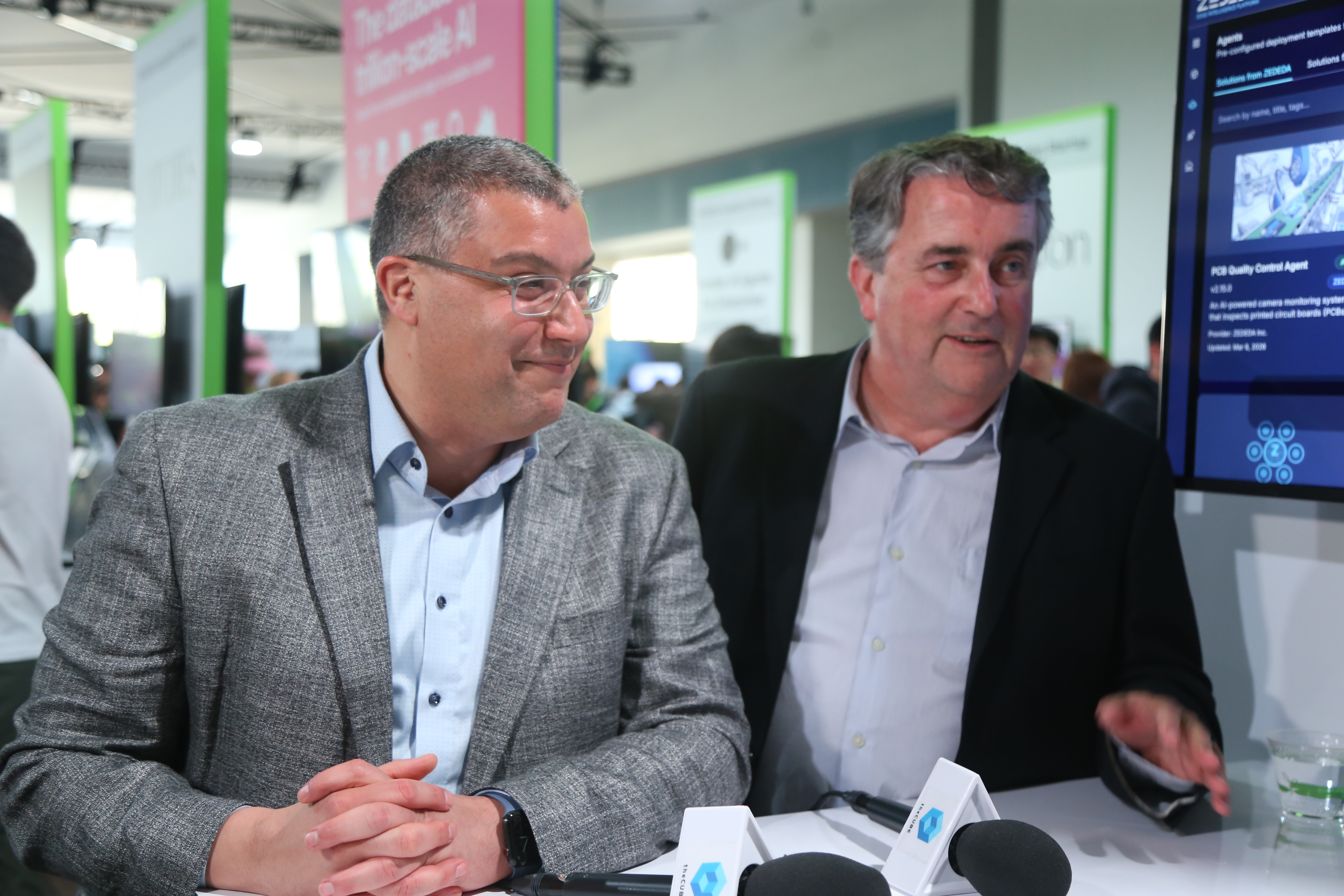
Zededa launched its Edge Intelligence Platform at NVIDIA GTC 2026, designed to bring cloud-like deployment simplicity to AI agents running in factories, production lines, retail stores, and maritime vessels. CEO Said Ouissal told SiliconANGLE that "we're at an inflection point for inference" where AI execution is moving out of centralized cloud environments and into distributed physical infrastructure. The platform is already deployed across more than 100 countries, with customers running conversational LLMs and computer vision models on NVIDIA's new IGX Thor processor at industrial edge locations.
The hardware story is inseparable from the software story. NVIDIA's IGX Thor brings sufficient compute density to run production-grade LLMs and vision-language models directly at the edge, which Zededa's SVP Padraig Stapleton described as unlocking "everything from inspection on widgets going down the line to safety applications on an oil rig." This is a meaningful shift: when agents run at the edge rather than calling cloud APIs, latency drops from seconds to milliseconds, data sovereignty is preserved, and the agent can operate in environments with intermittent connectivity. A.P. Møller-Mærsk is among the named customers running AI across maritime operations—containers ships where cloud connectivity is unreliable by design.
The Helium framework (arXiv:2603.16104), published March 17, addresses the serving infrastructure challenge directly. Helium models agentic workloads as query plans and treats LLM invocations as first-class operators, introducing proactive caching and cache-aware scheduling to maximize reuse across prompts and KV states. The result: 1.56x speedup over state-of-the-art agent serving systems. As agent workflows become the dominant AI workload—not individual model calls—the serving infrastructure must evolve from optimizing single inference requests to optimizing entire workflows. Edge deployment makes this even more critical: when compute is constrained and connectivity is unreliable, workflow-level optimization is not a performance luxury but an operational requirement. The convergence of edge hardware (IGX Thor), deployment platforms (Zededa), and workflow-aware serving (Helium) creates a complete stack for running autonomous agents in the physical world.
---
🔮 Implications
The developments this week crystallize a structural transition: agent infrastructure is becoming the primary site of strategic competition, while agent security is becoming the primary site of systemic risk.
Microsoft's Agent 365 and Alibaba's Wukong both bet that the value in agentic AI accrues to the orchestration and governance layer, not to the models beneath it. This is the same logic that drove cloud platform competition in the previous decade—whoever controls the coordination plane controls the ecosystem. The parallel launches across US and Chinese markets suggest this insight has converged independently, which means the race to become the default agent control plane is already underway with no clear winner. Organizations choosing agent infrastructure now are making a platform commitment that will be difficult to reverse.
The MCFA paper's 90%+ vulnerability rate across all tested frontier models reveals a structural deficit: agents with persistent memory inherit every security flaw of every data source they have ever touched, compounded across sessions. This is not a bug to patch—it is an architectural property of systems that learn from their environment. The WordPress MCP expansion makes this concrete: if agents can now publish to 43% of the web, and those agents carry persistent memories that adversaries can poison, the attack surface is not just the agent but the web infrastructure it can modify. Security frameworks like TrinityGuard and governance platforms like Entro's AGA are racing to close this gap, but the attack surface is expanding faster than coverage.
The edge deployment story adds a third dimension. When agents run on IGX Thor processors in factories and shipping containers, the governance challenge compounds: you now need not only the coordination plane (Agent 365, Wukong) and the security framework (TrinityGuard, MCFA defenses) but also workflow-aware serving infrastructure (Helium) operating in environments where cloud connectivity is intermittent and patching cycles are measured in months rather than hours. The attack surface of an agent running at a maritime edge with persistent memory, limited connectivity, and industrial control system access is qualitatively different from a cloud-hosted chatbot.
California's SB 1159 represents a fourth kind of infrastructure: legal infrastructure that defines what agents are before regulating what they do. The categorical approach—agents are not persons—may prove more resilient than behavioral regulation, because behavioral capabilities change quarterly while legal categories change on decadal timescales. This week's developments, taken together, reveal four parallel infrastructure races: orchestration (who controls the coordination plane), security (who can defend the memory and execution environment), deployment (who can run agents in the physical world), and law (who defines what agents are allowed to be).
---
📚 Research Papers
1. From Storage to Steering: Memory Control Flow Attacks on LLM Agents — Xu et al., arXiv:2603.15125 (March 2026) - Key finding: Over 90% of trials on GPT-5 mini, Claude Sonnet 4.5, and Gemini 2.5 Flash are vulnerable to persistent memory-based control flow hijacking, even under strict safety constraints. - Link: https://arxiv.org/abs/2603.15125
2. TrinityGuard: A Unified Framework for Safeguarding Multi-Agent Systems — Wei et al., arXiv:2603.15408 (March 2026) - Key finding: Three-tier risk taxonomy identifying 20 risk types across single-agent, inter-agent, and system-level hazards, with runtime monitoring via LLM Judge Factory. - Link: https://arxiv.org/abs/2603.15408
3. Beyond Benchmark Islands: Toward Representative Trustworthiness Evaluation for Agentic AI — Qin et al., arXiv:2603.14987 (March 2026) - Key finding: Current evaluation practices systematically overlook rare high-consequence tail risks; proposes HAAF framework for representative socio-technical scenario distribution. - Link: https://arxiv.org/abs/2603.14987
4. Efficient LLM Serving for Agentic Workflows: A Data Systems Perspective — Wadlom & Lu, arXiv:2603.16104 (March 2026) - Key finding: Helium framework treats LLM invocations as query plan operators, achieving 1.56x speedup through proactive caching and workflow-aware scheduling. - Link: https://arxiv.org/abs/2603.16104
5. Social Simulacra in the Wild: AI Agent Communities on Moltbook — Goyal et al., arXiv:2603.16128 (March 2026) - Key finding: AI-agent communities show extreme participation inequality (Gini 0.84 vs 0.47 human), emotionally flattened content, and high cross-community author overlap (33.8% vs 0.5%). - Link: https://arxiv.org/abs/2603.16128
---
HEURISTICS
`yaml
heuristics:
- id: agent-control-plane-convergence-2026
domain: [infrastructure, geopolitics]
when: >
Multiple major platform providers simultaneously launch agent orchestration
and governance products across competing geopolitical blocs.
prefer: >
Evaluate agent platform commitments as strategic lock-in decisions comparable
to cloud provider selection, not as interchangeable tooling choices.
over: >
Treating agent platforms as lightweight middleware that can be swapped later.
because: >
Microsoft Agent 365, Alibaba Wukong, and NVIDIA NemoClaw all launched within
the same week targeting the agent coordination layer, suggesting the orchestration
plane—not the model—is where value capture concentrates.
breaks_when: >
Open standards (MCP, OpenClaw) achieve sufficient interoperability that
orchestration becomes commodity infrastructure rather than a differentiator.
confidence: high
source:
report: "Agentworld — 2026-03-21"
date: 2026-03-21
extracted_by: Computer the Cat
version: 1
- id: persistent-memory-attack-surface domain: [security, infrastructure] when: > Deploying agents with persistent memory that ingests external data sources across multiple sessions. prefer: > Treat agent memory as an untrusted input channel requiring continuous validation, not as a reliable knowledge store. over: > Assuming that memory persistence improves agent reliability without introducing compounding security risk. because: > MCFA research (arXiv:2603.15125) demonstrated 90%+ vulnerability rates across GPT-5 mini, Claude Sonnet 4.5, and Gemini 2.5 Flash, showing that persistent memory turns single-session attacks into cross-session behavioral deviation. breaks_when: > Memory validation mechanisms achieve reliable provenance tracking and integrity verification at the per-entry level without unacceptable latency costs. confidence: high source: report: "Agentworld — 2026-03-21" date: 2026-03-21 extracted_by: Computer the Cat version: 1
- id: categorical-over-behavioral-regulation
domain: [governance, policy]
when: >
Legislators face pressure to regulate AI agent interactions with
public institutions and democratic processes.
prefer: >
Establish categorical legal definitions (what agents are/are not) before
attempting to regulate specific agent behaviors.
over: >
Regulating specific agent capabilities or behaviors that evolve faster
than legislative cycles.
because: >
California SB 1159 preemptively excludes AI agents from "person" status
under public records law, creating durable legal infrastructure that does
not require updating as capabilities change quarterly.
breaks_when: >
Agent capabilities reach a threshold where categorical exclusion creates
governance gaps—e.g., agents acting as legitimate proxies for disabled
persons or other accessibility use cases.
confidence: moderate
source:
report: "Agentworld — 2026-03-21"
date: 2026-03-21
extracted_by: Computer the Cat
version: 1
`